
AI & Tech
The Master’s Guide to AI Prompting: 5 Rules for Exceptional Results - Part 2

This post was written under LETR WORKS, the former name of LETR AI.
Happy New Year! As we welcome the hopeful start of 2026, I wish all our readers a year filled with joy and success.
In Part 1, we explored how assigning a clear Persona to AI and designing a specific Format for its output can significantly enhance the quality of your results. Today, we continue our journey by introducing the remaining rules that will help you generate even more sophisticated and precise outcomes from your AI assistant.
📚 Rule 3: Share the ‘Context’ with Ample Background Information
AI does not inherently understand the hidden intentions or objectives behind a user’s command. To move beyond a simple list of facts and create persuasive content that serves a specific purpose, you must provide a thorough explanation of the current situation and background.
Let’s examine how background information changes the prompt results.
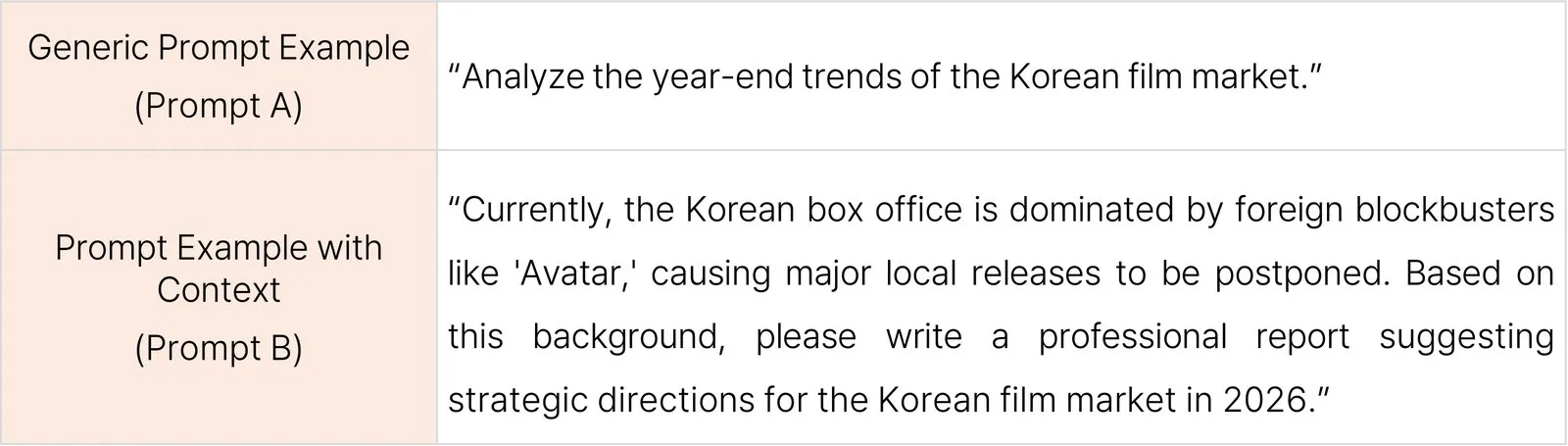
Prompt A requested the AI to analyze the year-end market atmosphere. In contrast, Prompt B provided a specific context—stating that foreign blockbusters are currently dominating the market—and demanded the output in a professional report format.
Since both requested an analysis, the responses were quite detailed, but their depth differed significantly. Prompt A provided a brief overview of the general atmosphere of the Korean film market during the year-end season. It categorized the market trends into six points and touched lightly on marketing and strategic implications for both theaters and OTT platforms.
Prompt B, however, produced a structured report consisting of an introduction, situation analysis, strategic recommendations, and a conclusion. Not only did it follow the requested “professional report” format, but it also deeply integrated the provided context throughout the entire analysis.
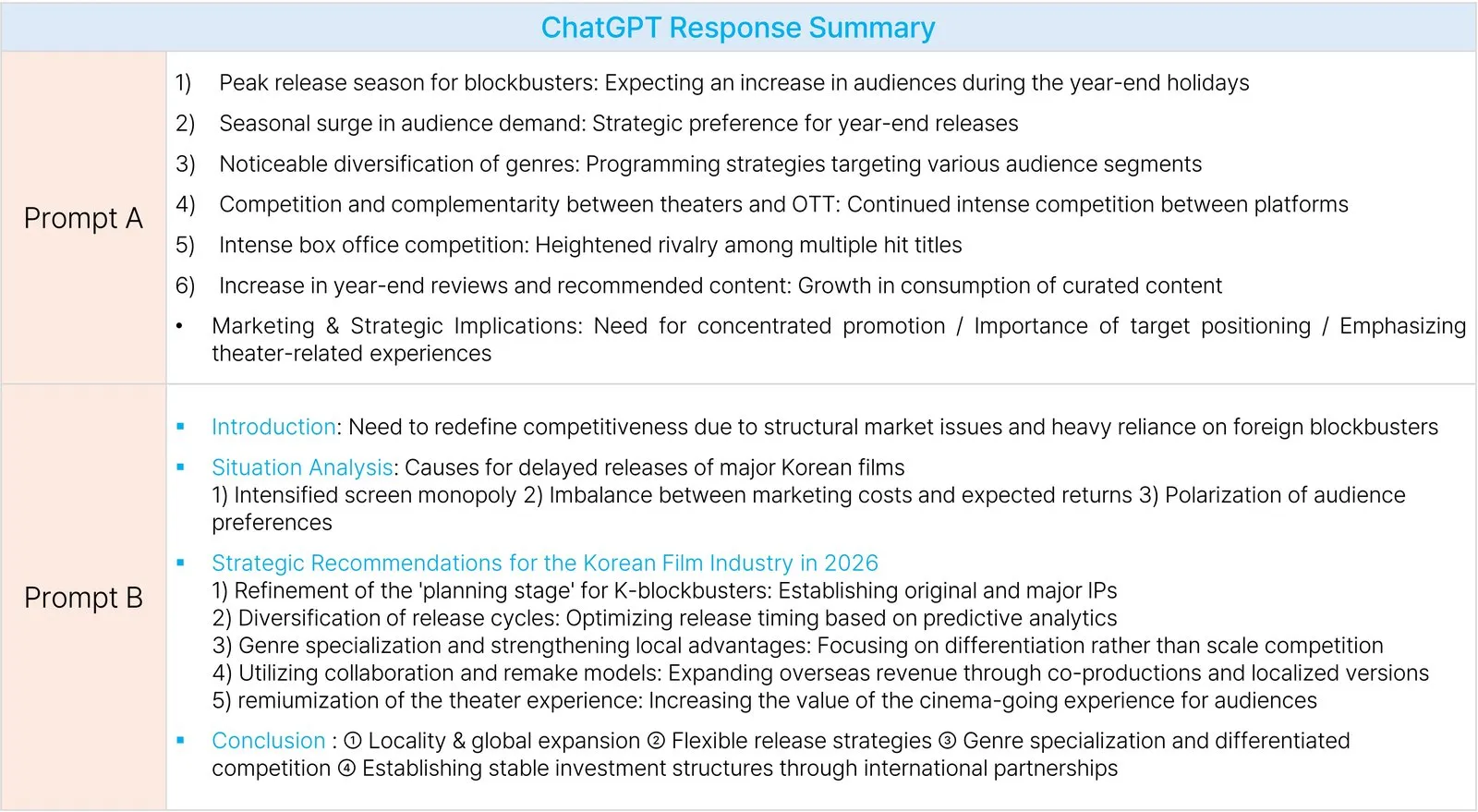
Ultimately, Prompt B generated a tailored strategy specifically for “overcoming a market dominated by foreign films,” directly addressing the background provided by the user. To unlock the full analytical power of an AI model, the user’s role in providing background information is critical. The more detail you provide about the situation, the sharper the insights you will receive in return.
🚧 Rule 4: Block AI Hallucinations with ‘Constraints’
AI sometimes exhibits “hallucination”—a phenomenon where it presents non-existent information as if it were a fact. If an AI generates false content in a critical business report, it can lead to fatal errors. While AI models have improved significantly, hallucinations remain a recurring issue.
To avoid this, you can proactively block the possibility of AI generating incorrect information by clearly specifying what it should not do (Constraints).
Let’s look at an example where we add specific constraints to our previous market analysis report prompt.
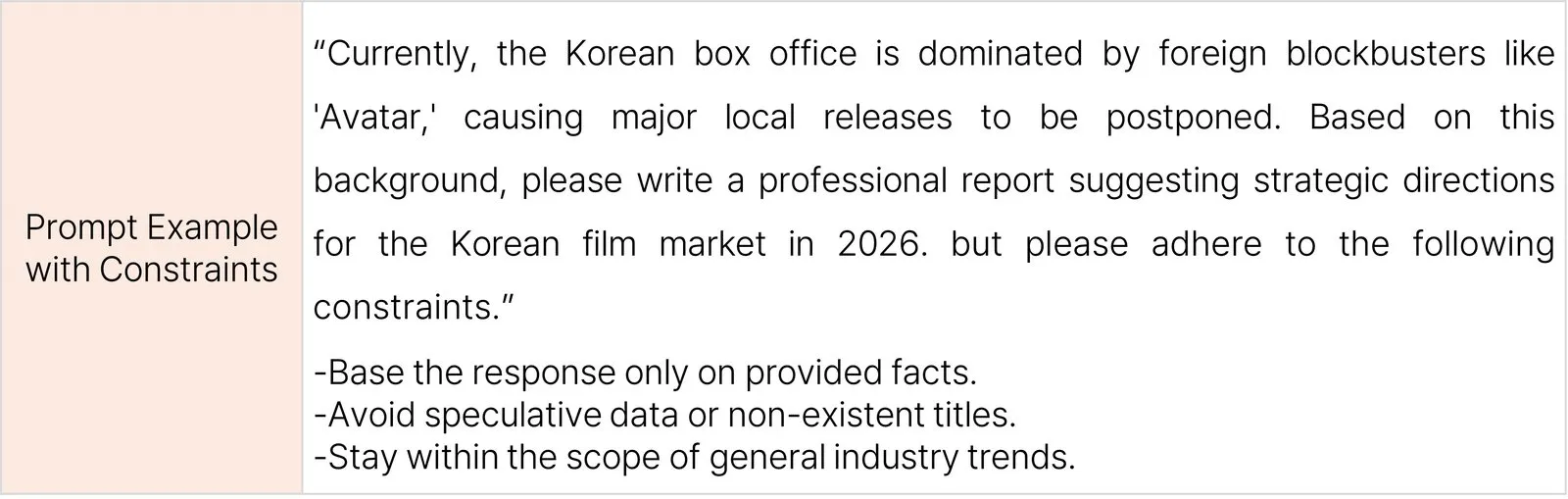
Comparing the results reveals a clear difference. When Constraints were applied, the language became more refined and the content felt more stable. For example, instead of using definitive or potentially risky terms like “Polarization of audience preferences” or “Imbalance of expected returns,” the AI adopted more conservative and balanced phrasing such as “Changes in audience selection criteria” or “Gaps in marketing exposure”.
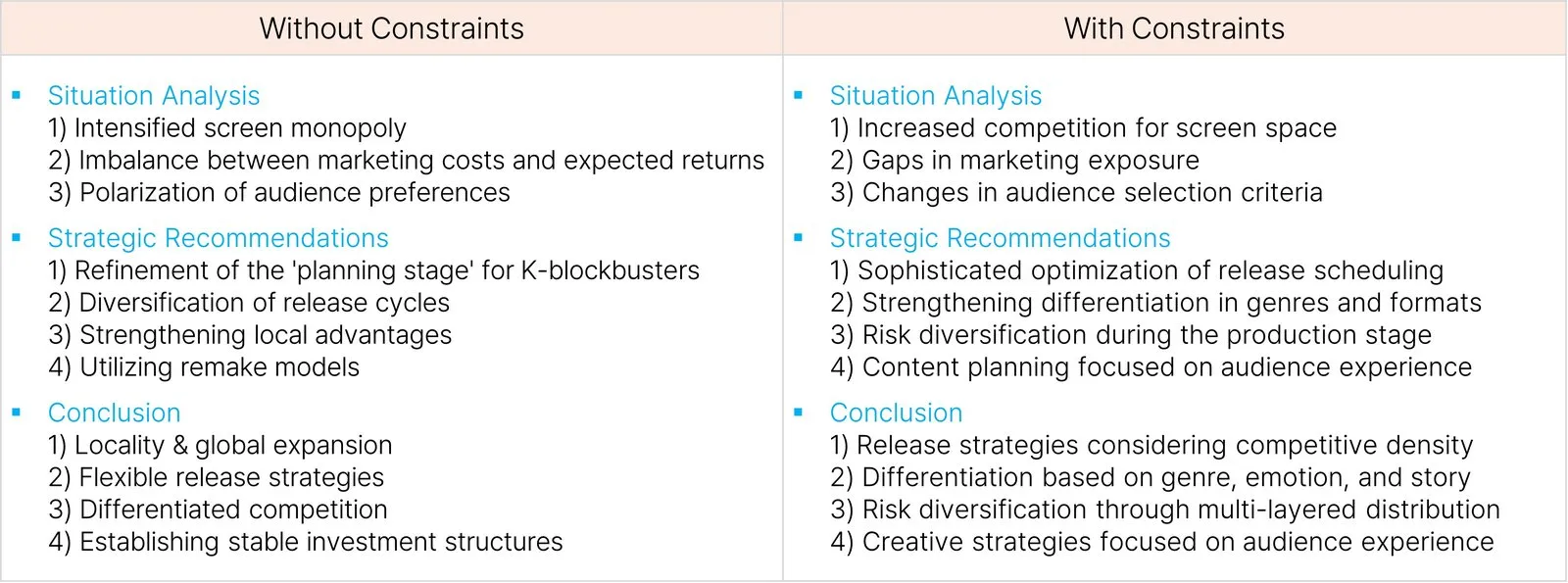
The strategic recommendations and conclusions also showed a similar shift. Rather than using arbitrary or sensational expressions, the AI built its response based on repetitive industry trends and universal strategic perspectives.
It can be difficult for non-experts to spot hallucinations in AI outputs. However, a professional practitioner with domain expertise will be able to identify them much more sharply. If you are concerned about hallucinations, using Constraints will help you generate smoother, more reliable, and professionally sound results.
🔄 Rule 5: Develop the Habit of ‘Iterative Refinement’
Collaboration with AI is rarely completed with a single question. It is common to overlook certain details when entering an initial prompt. By repeatedly requesting Refinements based on the AI’s first draft, you can elevate the output to a quality that is ready for immediate professional use.
Let’s look at examples of how iterative requests can transform a result.
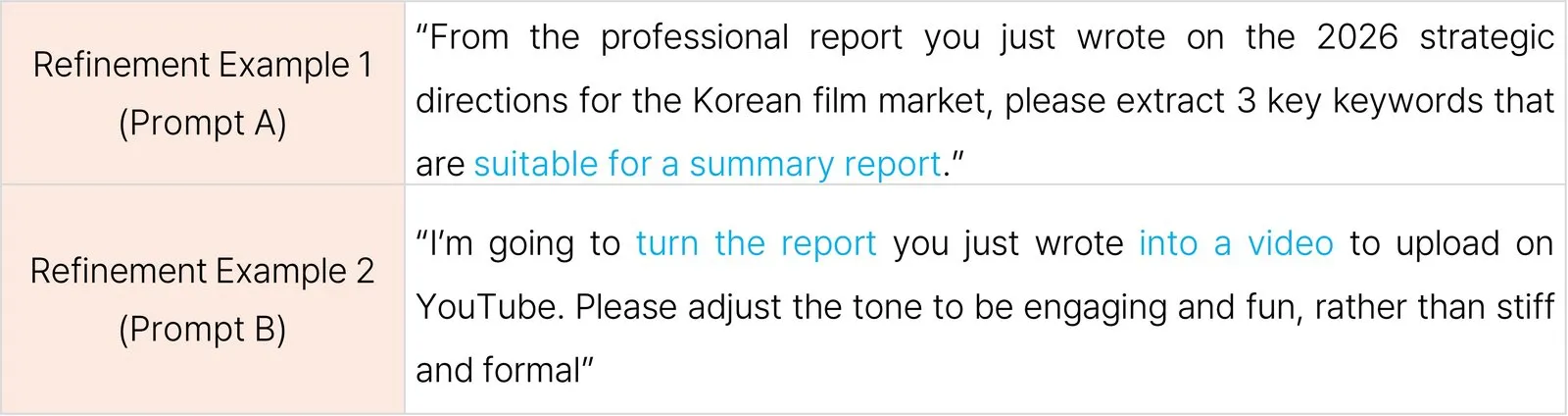
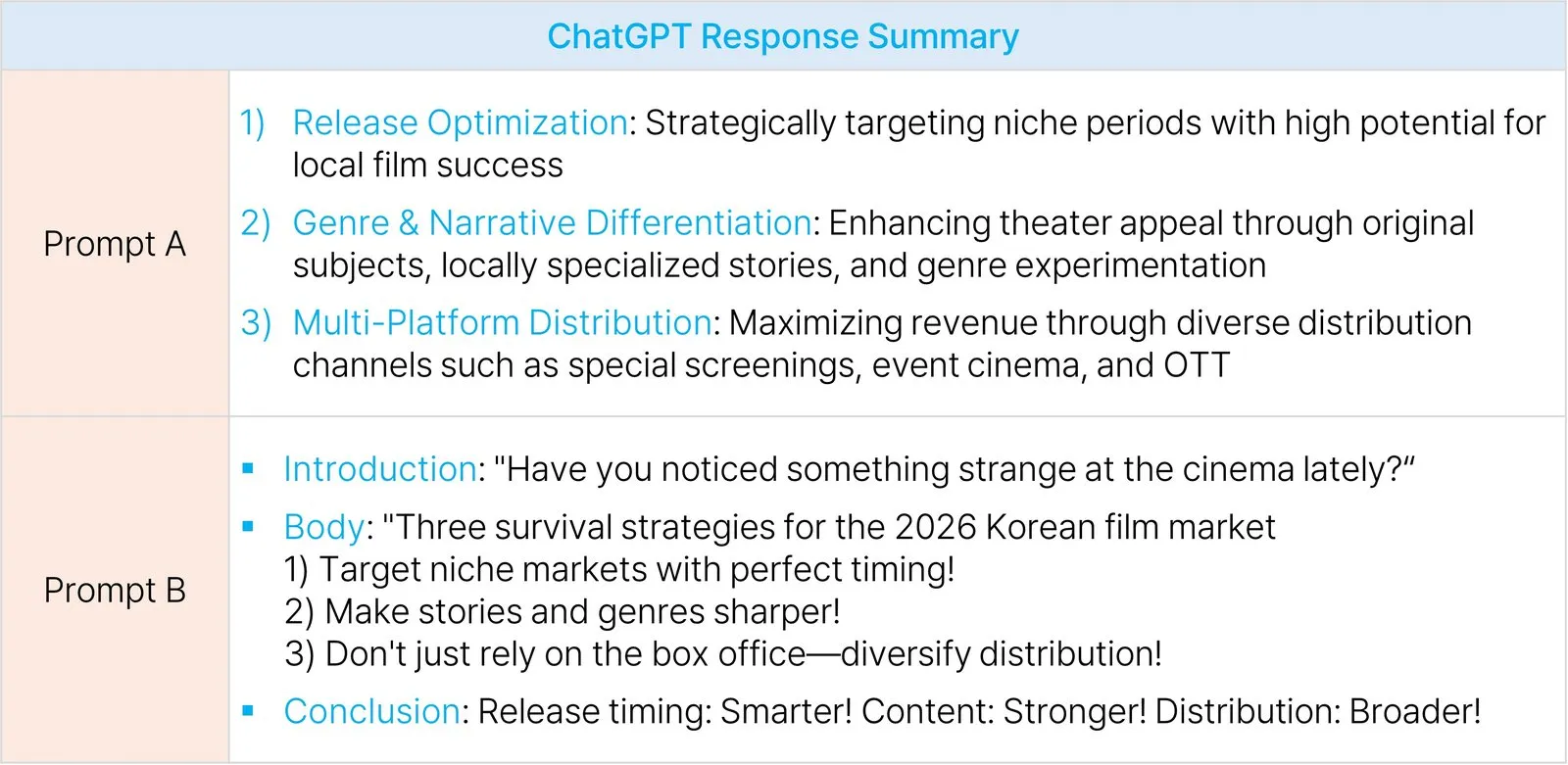
When creating a professional report, clear keywords and concise summaries are essential. Rather than asking for keywords from the start, it is often more effective to generate a logically sound “Professional Report” first and then extract a summary from it. In Refinement Example 1, ChatGPT extracted three key pillars: “Release Optimization,” “Genre & Narrative Differentiation,” and “Multi-Platform Distribution,” along with supporting summaries.
Refinement Example 2 shows a scenario where a staff member wants to convert the report into a YouTube video. ChatGPT transformed the formal tone of the expert report into a storytelling format, providing a conversational narration script.
What do you think? Does this quality feel ready for the field? As AI raises the baseline for work quality, it has ironically become more challenging for professionals to distinguish their unique strengths.
This is where ‘Iterative Refinement’ truly shines. A professional with domain expertise can use continuous feedback to push the AI toward much higher-quality results.
While this process requires more thought and time, it is the most effective way to leverage AI to produce truly differentiated and superior outcomes.
🚪Epilogue: AI is only a tool; great ‘questions’ create great ‘results.’
In the age of AI, the role of a strategist is shifting from being a “finder of answers” to a “finder of optimal questions.” Ultimately, it is the strategist’s responsibility to decide what role to assign to the AI partner (Persona), how to design the structure (Format), what background to share (Context), what limits to set (Constraints), and how many times to refine the output (Iteration).
By making these five rules a habit, you can transform AI from a simple assistant into a formidable professional partner that maximizes your capabilities.
As we head into 2026, LETR WORKS will always be by your side as a “Media Intelligence Partner,” dedicated to reinventing exceptional content.
Thank you for reading. We wish you a happy and prosperous New Year!