
AI & Tech
Marketing in the AI Era: Transitioning from Being ‘Searched’ to Being ‘Recommended’

This post was written under LETR WORKS, the former name of LETR AI.
As the sweltering summer heat fades, a cool morning and evening breeze signals the crisp, refreshing air of approaching autumn.
While the seasons change reliably, today’s business landscape feels more unpredictable than ever. Escalating global uncertainties, persisteni nflation, and fierce market competition across all sectors make promoting our brands, content, and products an increasingly steep uphill battle.
On top of these challenges, a fundamental paradigm shift is transforming the marketing game: the transition from the era of ‘Search’ to theera of ‘Recommendation.’
Today, we take a look at how your brand can move beyond traditional keyword rankings to become a brand that LLMs proactively recognize and cite.
🔍From the Search Bar to the Age of AI Recommendation
Until recently, finding information meant typing concise keywords into a search box—combinations like “best restaurants in Gangnam,” “how to edit 4K video,” or “B2B marketing case studies.” We scrolled through pages of links, clicking one by one to piece together the answer we needed.
This process was so ubiquitous we coined the term “Googling.” Most of us knew at least one colleague who was particularly skilled at Googling to pull up exact answers for work or daily life.
Today, however, users no longer just throw disjointed keywords into search bars. Instead, they engage in natural conversations with LLMs like ChatGPT, Gemini, and Perplexity, asking complex questions about everyday needs and strategic business challenges alike:
“Suggest effective ways to repurpose our brand promotional video from H1.”
“What strategies can we use to pitch our newly completed drama series to international OTT platforms we haven’t partnered with before?”
This shift in search behavior has fundamentally reshaped how information is consumed. Traditional search engines put the burden on users to choose what to click among dozens of blue links. In contrast, LLM-driven search analyzes intent and context to deliver a direct answer alongside a handpicked selection of top-recommended brands.
Where marketing once centered on who could dominate top search results (SEO) to drive clicks, the battlefield has now shifted: Which brand will the AI cite and recommend when generating its answer?
💡What is GEO (Generative Engine Optimization)?
If you search for your brand or service on ChatGPT or Gemini, you might find yourself asking: “Why isn’t our brand showing up?” or “When I asked for recommendations in our industry, why did it only list our competitors?”
Traditional SEO (Search Engine Optimization) focused on aligning site keywords and backlinks for web crawlers (like Google or Naver) to index. In contrast, GEO (Generative Engine Optimization) is a new framework designed to help an LLM’s reasoning and inference engine recognize your brand as a trusted information source.
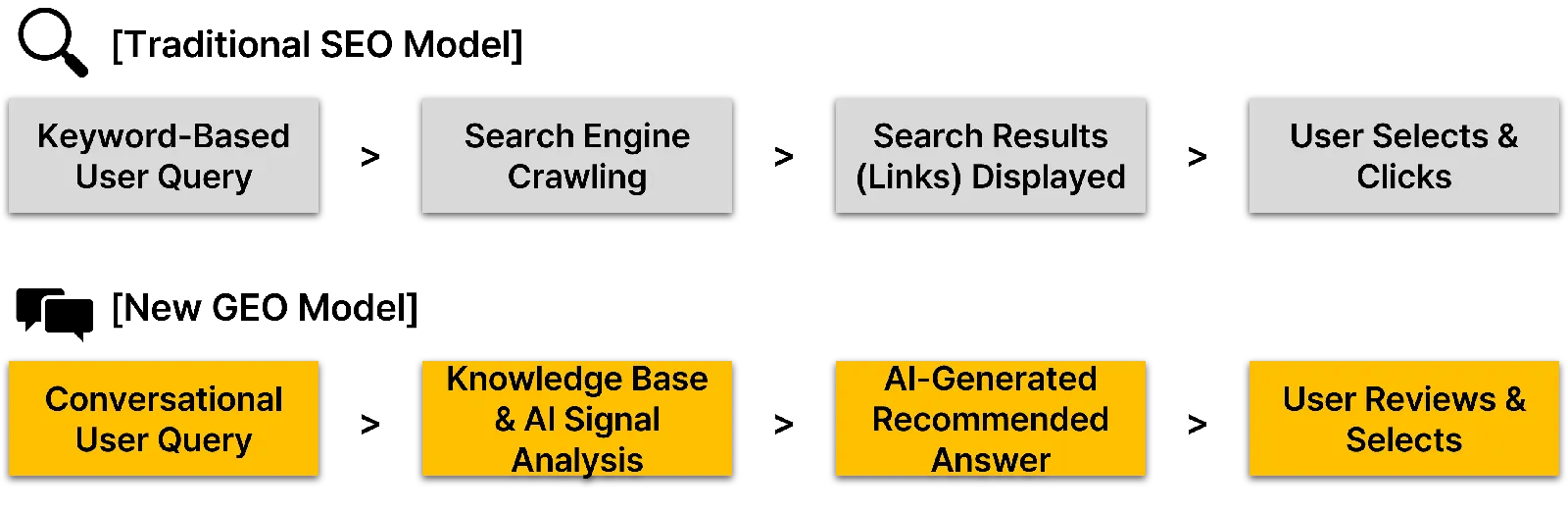
To succeed with GEO and get recommended by LLMs, it is essential to understand two core concepts:
1) Visibility: Does the LLM know your brand exists?
Your brand, content, and product data must exist within the LLM’s pre-training datasets or real-time search index. Beyond simple website text, your media assets—such as videos, audio, and documents—must be structured in an AI-Ready format so models can parse them effortlessly.
2) Discoverability: Does the LLM recommend your brand in context?
When a user asks, “Can you recommend a good family adventure movie?” the LLM should understand the context—analyzing parameters like ‘movie,’ ‘family adventure,’ and ‘streaming platform.’ It needs to retrieve your content as the optimal answer and even suggest where it can be streamed. For an LLM to cite your brand, your data must go beyond raw keywords to feature finely mapped contextual relationships and AI signals.
Ultimately, GEO is the strategic and technical process of converting your brand’s content and media assets into AI-friendly data, ensuring your brand is picked up and surfaced by LLM recommendation engines.
🤖How to Get LLMs to ‘Recognize and Recommend’ Your Brand
So, when AI generates recommendations for brands, products, or content in a specific industry, how can you ensure it cites your brand over competitors?
Based on the core criteria LLMs use to evaluate solutions, here are three actionable GEO strategies you can implement right away:
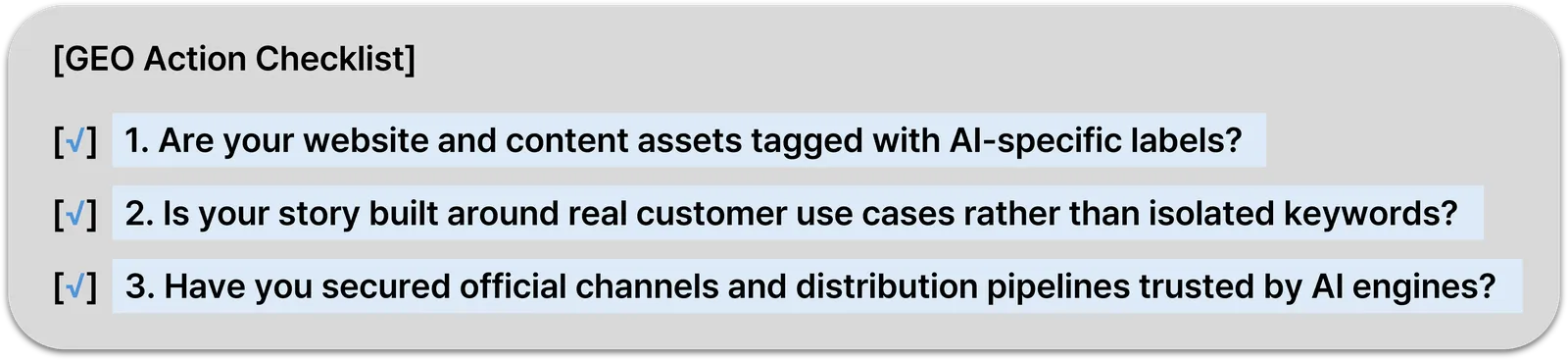
1) Build Structured Metadata That AI Can Easily Parse
LLMs cannot appreciate sleek website designs or eye-catching visual graphics the way humans do. However, they excel at reading the underlying data structures.
Text Assets: Beyond simply publishing brand content on blogs or landing pages, implement structured data like Schema.org standard tagging or JSON-LD. Defining your brand’s core purpose, product features, and target use cases in this format enables AI to understand your context without ambiguity.
Media Assets: Video, audio, and PDF catalogs hidden behind closed systems remain invisible to AI without intentional effort. Converting internal assets into AI-Ready metadata—such as detailed transcripts, scene-by-scene descriptions, and contextual tags—is the crucial first step toward establishing visibility.
2) Map Context and ‘Use-Case’ Data Instead of Isolated Keywords
LLMs prefer a single well-defined scenario explaining “when and why this brand is needed” over a article repeating a standalone keyword ten times.
When creating marketing content, avoid generic declarations like “We are a leading kitchen appliance company.” Instead, frame your content around real customer pain points and detailed problem-solving journeys.
For example, positioning your product as “a high-speed blender designed for busy professionals to blend 3–4 varieties of fruit in under 60 seconds for a quick morning meal” provides rich contextual data across your marketing channels. When a user prompts an LLM with a similar real-world challenge, the AI will recognize your brand as the tailored solution to recommend.
3) Manage AI Trust Signals and Establish Verified Pipelines
AI engines rarely cite or recommend information from unverified or ambiguous sources. To mitigate hallucination risks, LLMs heavily prioritize source authority and data reliability.
To build this trust, consistently distribute brand information—such as proprietary tech specifications, government/public validation data, and official certifications—across high-authority third-party channels, media outlets, and your official site.
Even if certain core technologies or internal data are sensitive, drawing a clear line between proprietary assets and public-facing trust signals allows you to establish a secure, reliable pipeline that AI engines can confidently reference.
🚀In a World Where AI Answers Everything, Is Your Brand Ready?
The shift from searching keywords and navigating endlessly through blue links to asking AI and receiving tailored recommendations is already under way. Today, marketing success hinges on a critical question: Is your brand ready to be cited by AI?
Putting GEO into practice, however, presents clear operational hurdles. Tagging structured AI metadata onto extensive libraries of text, video, document, and image assets demands substantial time and labor. At the same time, exposing sensitive brand information externally raises legitimate concerns over security and IP risks for marketers and content managers.
To address these challenges and accelerate seamless GEO adoption, LETR WORKS is actively developing its new ‘AI Signal’ framework.
LETR WORKS’ AI Signal automatically diagnoses and quantifies how easily your brand and content assets are recognized and discovered by AI engines (Visibility & Discoverability). Moving beyond raw analysis, it delivers actionable, tailored strategies to measurably improve these metrics.
If you aim to maximize your brand’s presence in this evolving AI search ecosystem, start by auditing your current content assets and distribution channels.
By building compelling, contextual brand stories and maintaining consistent presence across trusted media, your brand can become the top solution LLMs surface and recommend. As you navigate the AI era, LETR WORKS is here to empower your brand with our upcoming AI Signal platform.
Thank you for reading!