
Localization
Meet Polyglat, who has a perfect score in the language exam I can speak 5 languages #2
This post was written under LETR WORKS, the former name of LETR AI.
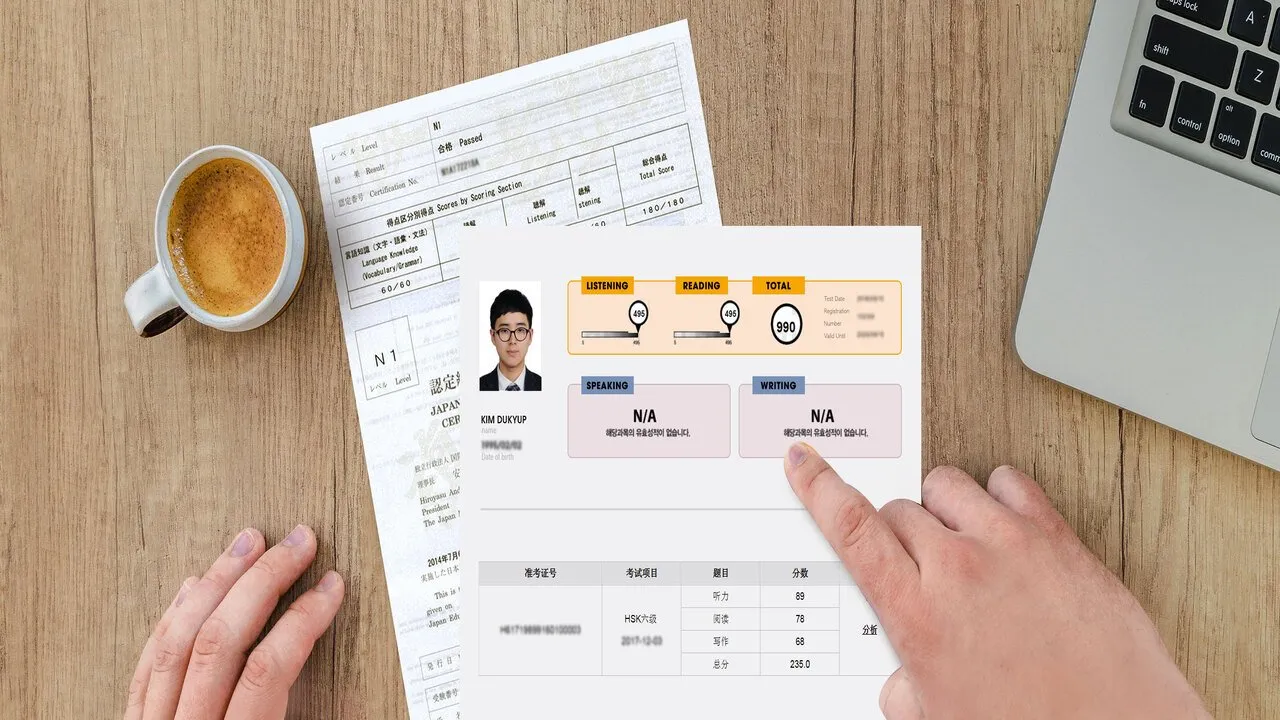
TOEIC 990 points & JLPT N1 180 points out of 180
When I was a child, it was a dream for many people, Speaking N languages!
Following on from my last post, I would like to introduce 2 interviews with Yup, a person who can speak 5 languages, and conquer 5 languages.

Q. What was the first language Y started studying and what motivated him?
As a foreign language, I learned English first. I lived in Seattle for about a year and a half when I was 8 years old.
I followed my parents to the US, and at first I didn’t know the alphabet, so I think I slept on my stomach during class. But over time, I think I’ve gotten closer to English… I came back to Korea when I was in the 3rd grade of elementary school.
After that, I came across Japanese, but I didn’t study it. Hehe, I’ve come to love Japanese animation. Especially Inu XX. I continued to watch animations on the internet until I was in middle and high school, and in the process, I learned about the JLPT N1 exam. My first level of study was when I started JLPT after memorizing all hiragana, and I got a perfect score after studying for 6-7 months. If I had to say this, “JLPT perfect score in 7 months,” the only thing you’ll see is that it’s not that I get a perfect score in 7 months; it was my first time at JLPT, but I was already familiar with a lot of anime in Japanese when I started studying. You should think that I started studying when I had some familiarity with Japanese. However, after receiving a JLPT N1 perfect score, I was convinced that domestic students, not overseas students, can excel at studying languages.
Q. Is interest the best motivator?
I’d like to say that I’m interested in content rather than interest in language. I think English and other languages are the same.
I think I was able to get to the level of business English because I continued to consume English content such as books and dramas, so I was able to get a full TOEIC score.
Q. What about Chinese and Spanish?
Personally, Chinese was the most difficult. Chinese characters and tones were the most difficult, and above all, I think it was even more difficult because I lived in China for a year and a half but didn’t have the opportunity to use Chinese often. In the process, while thinking about an efficient method, I was curious about how rich people can learn languages. I was curious about how people who give and receive 1 to 2 million won per hour teach and study.
I studied the structuring of language learning by studying language learning methodologies and approaches. When I think about it now, I think what was disappointing was that they were less able to consume Chinese content than Japanese content.
When studying Spanish like that, I think I studied most effectively by using the structured method I learned while learning Chinese.
I think I made good use of the language learning process by using tools like Anki, which were introduced on my YouTube.
Also, I think the environment where I spoke Spanish in order to survive had a positive effect. I lived in Mexico for 6 months, and I hardly understood English, so I was even more desperate.
I also structured Spanish, so I studied for 6 months, and I think I was able to speak better compared to the time period.
Q. In your opinion, what is a good language for Koreans to study?
It depends on what purpose you approach the language, but when I think about Korean, I think Japanese is the easiest language to learn.
The biggest part is pronunciation and word order. The difference between “rock” and “lock” is important in English, but I think there is a limit to how to distinguish these pronunciations in Korean. The same goes for Spanish and Chinese.
However, I think Japanese is similar to Korean in many ways. There are many similar pronunciations, and the word order is similar. Above all, there is a lot of content that can be consumed in Japanese, so I think it’s easy to access.
That’s why I recommend Japanese.
Q. If you were to learn a foreign language again, what would you do in order to learn it?
I learned English > Japanese > Chinese > Spanish in that order, but in terms of efficiency, I think I’ll learn Japanese > Chinese > English > Spanish.
Japanese kanji are closer to traditional Chinese characters, but if you only know about 2000-3000 characters, I think 90% of the time there is no problem when reading documents or in everyday life. In comparison, I think you need to know about 5000-6000 characters in Chinese. Additionally, after I went to China, I learned to use my own hands for training, and I think it helps both in studying Japanese and Chinese. I think English and Spanish, which are similar families, are similar within the same context.

Q. The secret to getting a perfect score on the language exam! What’s the most important thing? vocabulary? Solve a lot of questions?
We study for tests, but I think it would be good to first think about the fact that studying for tests may not be efficient.
Rather than preparing for TOEIC because you want to get TOEIC, I think the ideal is to study English and get TOEIC.
I just prepare for the exam for various reasons, but basically preparing for the exam isn’t fun, right? If I study JLPT Japanese phrases for 1 hour, I usually just hold on, but if I read 3-4 Japanese comic books that I like, I’ll be able to read more than 4-5. If you look at this over a period of 6 months or 1 year, I think there will be a difference in reading comprehension, and there will be a big difference in the volume of reading and listening. Nor is it a style where you prepare for tests on your own.
In summary, I wanted to say that I broadened my volume, and my approach as a test was short-term; I took a strategic approach by spending 5 months of English content during the 6 month TOEIC study period and going to school for 1 month.
As an aside about the test, I think I often get the wrong answers in the options when I look at the test questions for a long time while studying for an exam. (In particular, if you take the “fill-in-the-blank question” in any language test as an example) If you keep putting in the wrong answers without skills, the time spent exposed to the wrong language will increase, and my brain will recognize and absorb it without even knowing it. Therefore, I don’t really recommend studying any test by repeating blank questions over a long period of time. On the contrary, it seems to tend to be confusing.
Q. So how do I study vocabulary? Isn’t everyday vocabulary different from test vocabulary?
Nevertheless, the vocabulary wasn’t much different. Watching and listening to everyday content helped me a lot. Even when looking at people who speak multiple languages around them, there are many cases where they focus on everyday language rather than people who focus on any vocabulary in one field. Raising volume! Of course, the language education market in Korea is special, so you can prepare short and bold, but I think it’s always a good idea to think about volume if you want to get a certificate while speaking a language.
Also, while studying, I hardly opened a dictionary. Personally, I think that finding a dictionary makes it less accessible. I just watched it because I thought I was looking at a picture. There was a lot of fun content just by looking at pictures, and specific words were repeatedly exposed through it, and I saw it as a feeling. I checked only the words that were repeated later and focused on watching, reading, and studying for about 30 minutes to 1 hour. The most effective way is to frequently expose words like flashcards to remind them when they’re having a long time.
Q. Do you have a business plan?
I like meeting people and the language itself, so I don’t have any plans to do business with a language yet. I’m very busy with work right now, and I think I’ll have to reconsider in the far future.
Q. Lastly, please share some language learning tips.
Thank you for this interview opportunity. No matter what you’re learning, I want you to see the language through content you love. I think the most efficient and reliable way to learn a language is to constantly consume content that you like because you like games or sports. Fight!
**
When I think about my memories from the time of the interview, my heart still feels majestic. There was a lot of resonance in the area of studying languages and thinking deeply about translation.
We hope you’ve got your own insights, and we’ll see you in the next post.
Please do Wel-Being today~
<em></em>Thanks again to Yup for the interview:)
*This content has been transferred from Gicon Studio to Letterworks.
🚀Experience the Data Intelligence Platform ‘LETR WORKS’ NOW!
• Try out the content of Notes firsthand! (One-month free trial available 🎉)
• Curious about how AI technology is applied? (Request a POC sample 💌)