
Localization
What if I run the translator for a SAT problem?
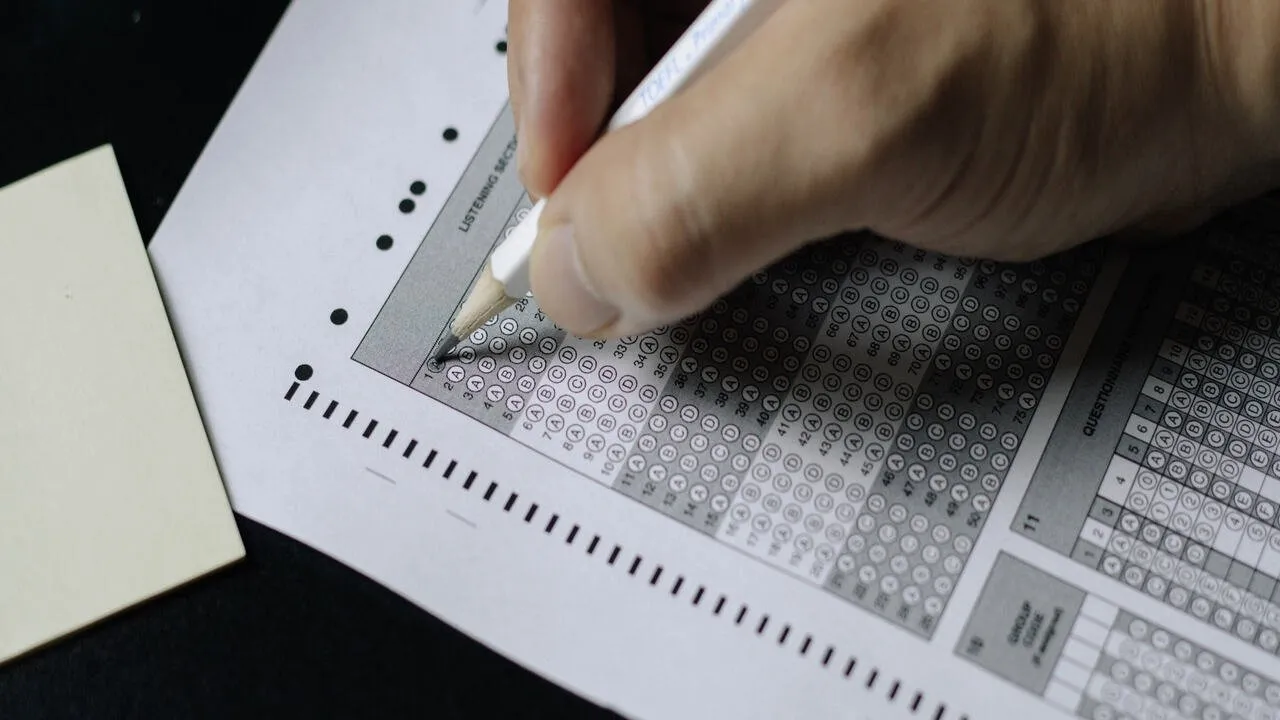
This post was written under LETR WORKS, the former name of LETR AI.
Solve the SAT problem with the translator running
Hallo
There’s only one month left until Thursday, November 19th.
What day is November 19th? This is the 2022 University Math Proficiency Test.
As SAT was just around the corner, American international students and Korean college students solved problems in the Korean language and English language fields.
Of course it wouldn’t be fun to just solve it, right? So I tried to solve the problems in the Korean language area and English domain after putting it all together on the translator. International students in the US are mainly asked to solve questions in the Korean language area by translating them into English (Korean > English), and Korean university students are mainly solved by translating English language problem sheets into Korean (English > Korean).
Think it would be easy because it’s your native language? Can’t you imagine two students working together to solve a problem?
Looking forward to seeing a Korean university student who relies on a translator and Mi-Cook-in mumbling English, check out the interview below together.
Q. Hello, please introduce yourself first.
Jessica
Hallo I’m Jessica, majoring in economics at Yonsei University. I’m a Mikook person. (Of course, I introduced myself in English… Check it out in the video 🤭)
Shiho
Hallo I am Park Si-ho, majoring in Chinese Language and International Management at Pusan University of Foreign Studies.
Q. Soon, SAT is, but how much do you two know about SAT?
Shiho
You see SAT in Korea once a year, in November, right? That day is unofficial, but everyone knows it’s the coldest day of the year. SAT is also SAT, but in our time, there were times before that, so I think I prepared a lot for college from time to time. Does the US have any time? It’s not sushi (Sushi), it’s anytime.
Jessica
Yes, there are early recruitment types called Early Decision and ED. Also, there are SAT and ACT tests in the US, which I think are similar to proficiency tests in Korea. As far as I know, the Korean SAT was also based on the US SAT. However, unlike SAT, you get a chance about 3 times a year.
So it’s not as psychologically tight as SAT. The test is also done with a pencil. (Korea is a sign pen for computers.)
*** Up to 7 times. Pro-SAT scores from the lower grades are also recognized. There is no age or number of times to take the test, so if you feel unsatisfied, you can take the test again. - Editor’s note
Q. The SAT Korean language section consists of 45 questions for 80 minutes,
In the English section, you must solve 45 questions in 70 minutes. Are you confident?
Jessica
I think the time for the Korean exam is always very tight.
Shiho
A, if you can solve only one fingerprint, of course, you have confidence.
After receiving the question, the two students were astonished. Check out the fingerprints below for yourself. 😁
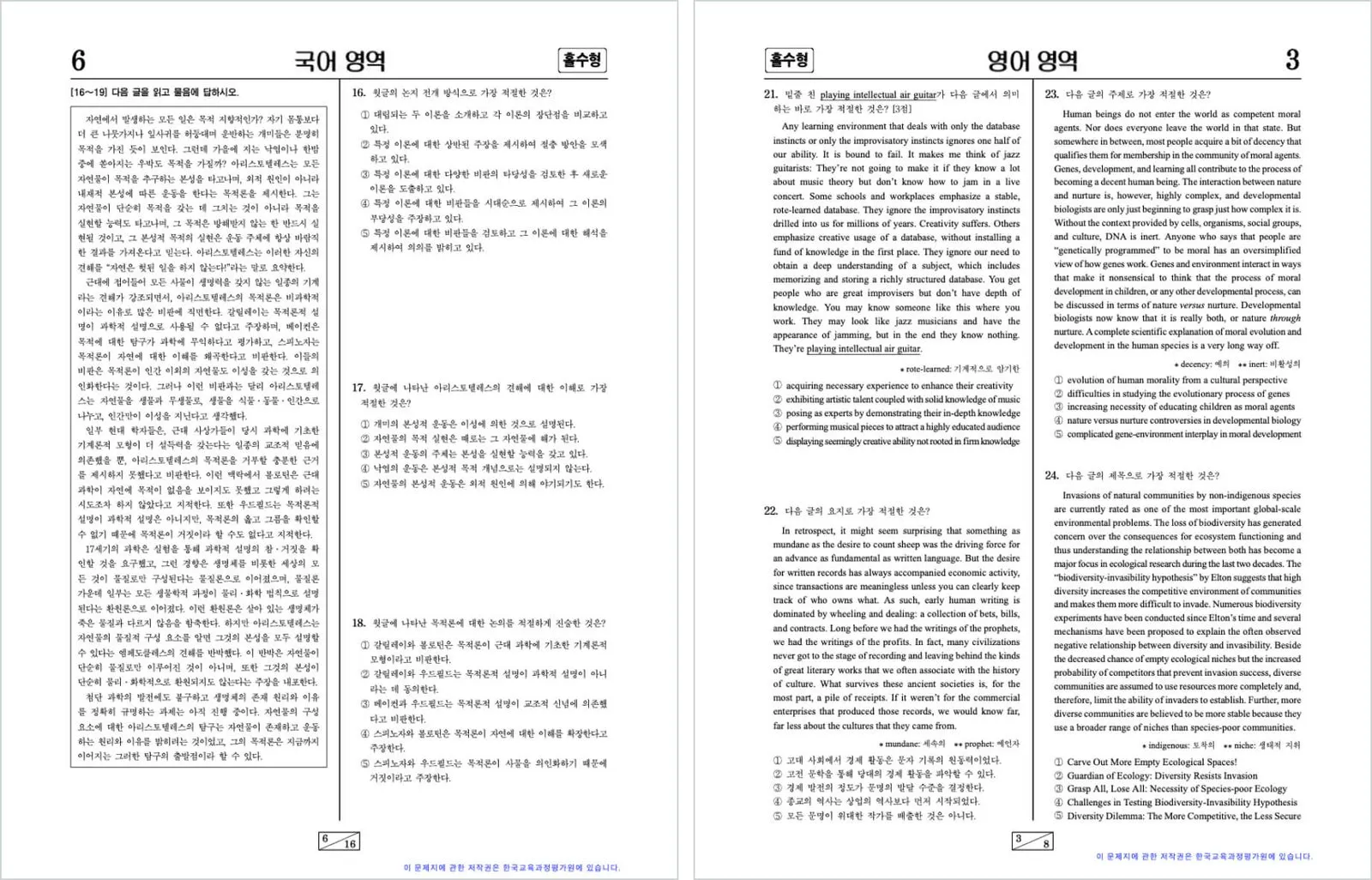
Below is a fingerprint of a problem solved by actual students (mixed with a translator). Due to time constraints, I will only cover one representative fingerprint.
This screen uses Google Translate from the Gicon Studio comparison translator.
In addition to Google Translate, you can also check the translation results of Papago and Kakao at a glance.
Everyone, too, can solve the fingerprint below yourself!
The questions are written uniformly in Korean, so please choose a fingerprint you are confident in and try to solve it.
#1 (Language area fingerprint > English translation)
Is everything that happens in nature purposeful? Ants that hurrifying transport branches and leaves is larger than their own bodies treating to have a purpose. But do fallen leaves in autumn or hail in the middle of the night have a purpose? Aristotle proposes the teleological theory that all natural objects are born with the nature to seek a purpose, and that movement affects an intrinsic nature rather than an external cause. He argues that natural objects don’t only have a purpose, but are also innate in the ability to realize the purpose, and that the purpose will be meant unless hindered. Aristotle summed up this view by appearing, “Nature does nothing in vain!” In the modern era, as the view that all things are a kind of machine without life force was considered, Aristotle’s teleology faced many criticisms for being unscientific. Galileo argues that teleological arguments cannot be used as scientific research; Bacon evaluates that the search for evidence is considered to science; and Spinoza criticizes teleology as distorting our understanding of nature. Their critique is that teleology prints natural objects other than humans as having reason. However, to these criticisms, Aristotle divided natural objects into living and non-living things and living things into plants, animals, and humans, and thought that only humans have reasons. Some modern scholars criticize modern thinkers for not arguing grounds to reject Aristotle’s teleology, arguing on a kind of dogmatic belief that the mechanistic models based on science at the time were more arguing. In this context, Bolotin points out that modern science has been shown nor even presented to show that nature is purposeless. Woodfield also points out that proven teleological findings are not scientific theories, teleology cannot be false because teleology cannot be verified right or wrong. Science in the 17th century required to confirm the truth or falsehood of scientific findings through experiments, and this trend led to the materialism that everything in the world, including living things, concerns only of matter. This led to the reduction theory that the process is involved by the laws of physics and chemistry. This reductionism explains that living things are no different from dead matter. Aristotle, however, refuted empedocles’ view that knowing the material components of a natural thing can explain all of its nature. This objection argues the assertion that natural objects are not simply made of matter, nor that their nature is simply reduced or chemically. Advances in advanced science, the task of arguing the principles and reasons for the difficulties of life is still in progress. Aristotle’s Quest for the Components of Natural Objects was to reveal the principles and reasons for the hazards and movements of natural objects, and his teleology could be said to be the starting point of such investigations.
Question 16) What is the most appropriate way to develop the above article’s thesis?
1. Two opposing are arguing and the arguing and arguing of each are involved.
2. A question is presented by arguments arguments for specific arguments.
3. After arguing the validity of various criticisms of specific criticisms, new considerations are derived.
4. Criticisms of Specific Criticisms Are Criticisms in Chronological Order to Assert the Injustice of the Theory.
5. It examines the criticisms of a specific theory and argues its consideration by arguing an argument of the theory.
(Question 17) What is the most appropriate way to understand Aristotle’s views in the article above?
1. The Natural Movement of Ants is caused by reason.
2. The meaning of the purpose of a natural object is sometimes conscious to that natural object.
3. The Subject of the Natural Movement has the ability to realize the nature.
4. The Movement of Leaves is not meant by the concept of intrinsic purpose.
5. The natural movement of natural objects is also drawn by external forces.
(Question 18) What appropriately stated the discussion on the theory of purpose shown in the above post?
1. Galileo and Bolotin criticize teleology as a mechanistic model based on modern science.
2. Galileo and Woodfield agree that teleological studies are not scientific studies.
3. Bacon and Woodfield criticize teleological investigation for treatment on dogmatic treatment.
4. Spinoza and Volotin argue that teleology explains our understanding of nature.
5. Spinoza and Woodfield argue that teleology is false because it personalised things.
#2 Fingerprint in English > Korean translation)
Question 23) What is the most appropriate topic for the next post?
Humans do not enter the world as competent moral actors. Nor does everyone pass away in that state. But somewhere in between, most people attain a decent qualification granted by a community of moral actors. Genes, development, and external learning all contribute to the laboratory for becoming a decent human being. But nurturing nature outside is very complicated, and developmental biologists are only just beginning to understand how complex it is. Without what cells, organisms, social groups, and free will provide, DNA is inert. People who say they are morally “genetically programmed” have an oversimplified view of how genes work. The extragenetic environment interacts in a way that makes it pointless to think that a comprehensive concept of a child’s moral development or any other developmental research can be discussed in nature versus nurture terms of use. Developmental biologists now know it’s actually both, or nature through nurture. Block’s scientific explanation of the external development of moral evolution in human subconceptions is still far away
1. Evolution of human morality from a cultural perspective
2. Difficulties in studying the process of gene evolution
3. Increasing need to educate children as moral actors
4. The nature versus nurture debate in developmental biology
5. Complex gene-environment interactions in moral development
Did you solve the problem together? The correct answer to the question will be revealed in a later video.
I feel that the level of difficulty has increased even more since the fingerprints for each area were transferred to the translator to proceed with the translation and solve the problem.
All the Korean SAT students who will be able to submit and solve this difficult problem, the competition committee members, and many stakeholders are fighting!
Q. How was it to use a translator to solve SAT problems?
Shiho
Of course, I thought it would be easy to translate English fingerprints and solve them in Korean, but it’s not as easy as I thought. The unique style of the translator seems to have made reading more difficult. Still, I had no problem understanding the meaning, so I was able to solve it. (The question is wrong, but actually I’m not wrong.)
Jessica
When I solved it by changing Korean to English, I was surprised that the translation was so good. There was no problem with the translation, but it was difficult to understand the content. Personally, I think the Korean SAT problem is a bit more difficult than SAT.
***
Check out the video for the SAT problem confrontation between an American international student and a Korean college student, and the rest of the more fun stories you couldn’t capture in the post while looking forward to who got it right the most!
👉 2022 SAT Special I How about solving SAT problems with a translator?
Additionally, you can check the submission questions by year/subject at the Korea Curriculum Assessment Institute.
👉 View Curriculum Assessment Institute proficiency questions
See you in the next post.
*This content has been transferred from Gicon Studio to Letterworks.
🚀Experience the Data Intelligence Platform ‘LETR WORKS’ NOW!
• Try out the content of Notes firsthand! (One-month free trial available 🎉)
• Curious about how AI technology is applied? (Request a POC sample 💌)