
Localization
Are translations also recommended?

This post was written under LETR WORKS, the former name of LETR AI.
Do you remember ‘Minority Report’, a film about a dystopian future? It was released in the early 2000s, so although it is a bit old, it seems that it is still being talked about today because it impressively expresses a dystopian future society. Personally, although it is a relatively common item of futuristic technology appearing in movies, I remember the scene where a display-type billboard recognizes the protagonist as he walks down the street and shows a “customized advertisement” in real time that might interest him.
Of course, such customized real-time display ads have not yet been introduced to the market. However, most of the services we are familiar with in our daily lives often already include “recommendations for me.” From social networks such as Facebook and Instagram to e-commerce such as Amazon and Coupang, and streaming services such as YouTube and Netflix, all have core competitiveness and revenue generated through “recommendations.”

Algorithm of recommendations
Due to the rapid development of technology in recent years, I am sometimes horrified that services seem to know me better than I do. It’s long gone beyond the simple level of collecting and showing products that are already selling well in online shopping malls. In addition to the explosive increase in usable data such as big data, cutting-edge technologies such as artificial intelligence (AI) have advanced, we are now providing personalized recommendations. Now, it technically tempts consumers by showing items they can buy and recommending content they might like.
However, since most recommendation algorithms make recommendations based on the degree of similarity between consumers, there are definitely limitations. For example, Cheol-su collects all the information on what items Cheol-su likes, and recommends products purchased by Young-hee, who has similar consumption patterns, that Cheol-su hasn’t purchased yet. Also, if Cheol-su bought a ballpoint pen, there is also a method of recommending a notebook that is often bought with the ballpoint pen. A more advanced method here is the content-based recommendation method recently used on YouTube, Netflix, etc. There are still gaps, but recent recommendations continue to make up for shortcomings while improving accuracy and satisfaction.
I also need translation recommendations
However, among the advanced services that have already become part of our daily lives, recommendations are still popular (?) What hasn’t been done is the translator. Despite the fact that cutting-edge artificial intelligence technologies such as deep learning (deep learning) and natural language processing (NLP) are used to make machines understand human language, recommendation functions are not very visible. This is because recommendations based on similarity between customers, which are mainly used in e-commerce, are often not suitable for use in translators where accuracy is paramount.
Although Google and Papago translators have already become inseparable from everyday life such as study and work, in fact, they are friends who are still somewhat lacking. Everyone has probably had this kind of doubt at least once while using a translator on a regular basis. “Is this translation correct?” , “Is this an expression actually used?” ,… Everyone has experienced this kind of anxiety. When that happens, I think it would be nice to be able to ask a native speaker or a friend with extensive experience abroad. However, if I don’t have such abilities among my close friends, the next best way to choose is to search Google for such questionable translations. I used to feel a little relieved when I saw multiple such expressions in Google search results, thinking that many English users around the world actually use them.
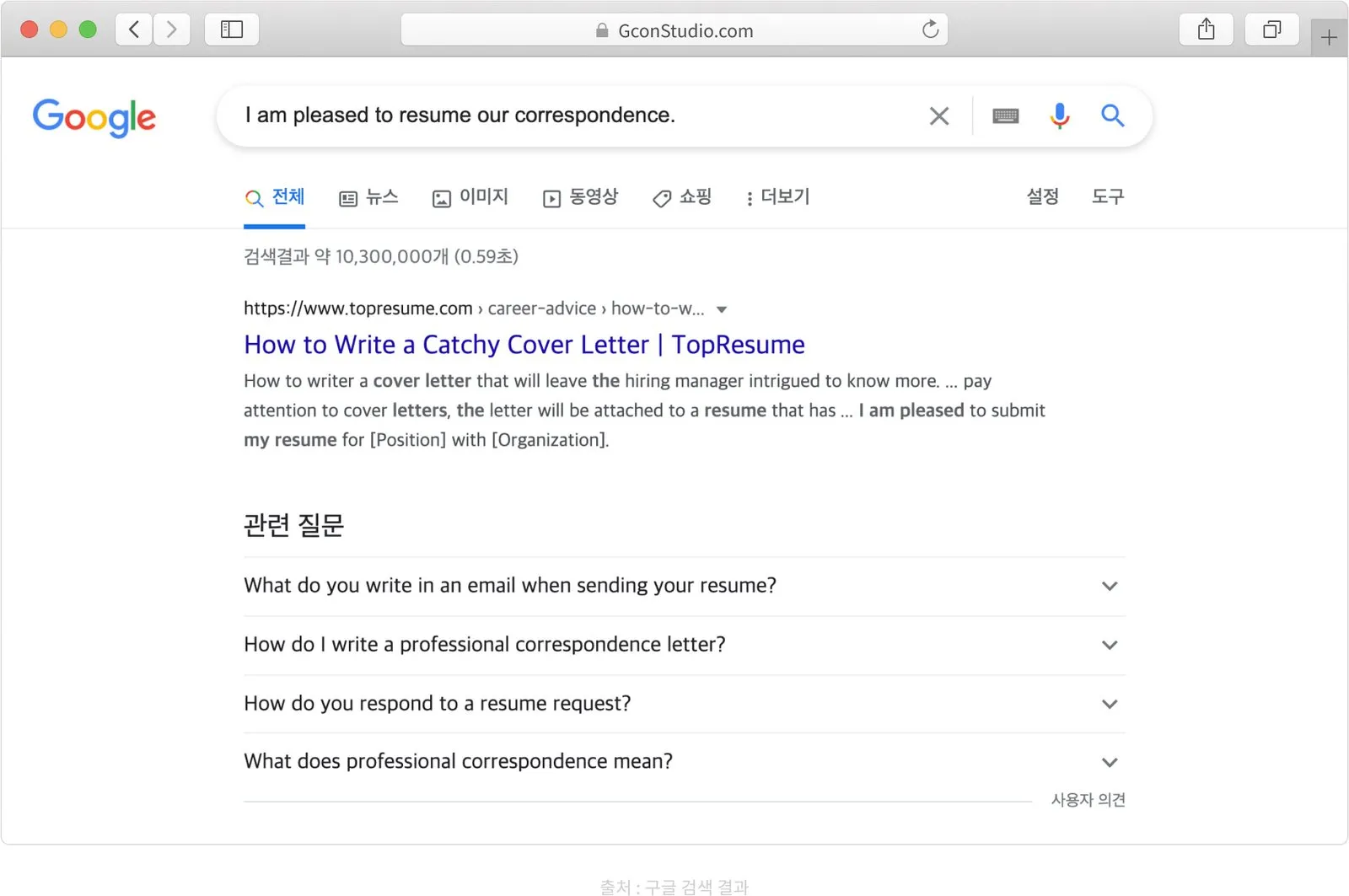
Recommended translator, Gicon Studio
In fact, it’s not easy to clearly define the conditions for a good recommendation. This is because there are so many different metrics to consider for good recommendations, such as accuracy, variety, and reproducibility. However, Gicon Studio has adopted a method of recommending the most commonly used terms or expressions for these potential evaluation indicators.
More specifically, I collect translation results from various translators such as Google, Papago, and Kakao i, compare different translations, and recommend translations based on the number (items) of Google search results that have accumulated vast amounts of language data from around the world. Therefore, there is a high possibility that the translation recommended by Gicon Studio is a term or expression actually used by people who speak that language.
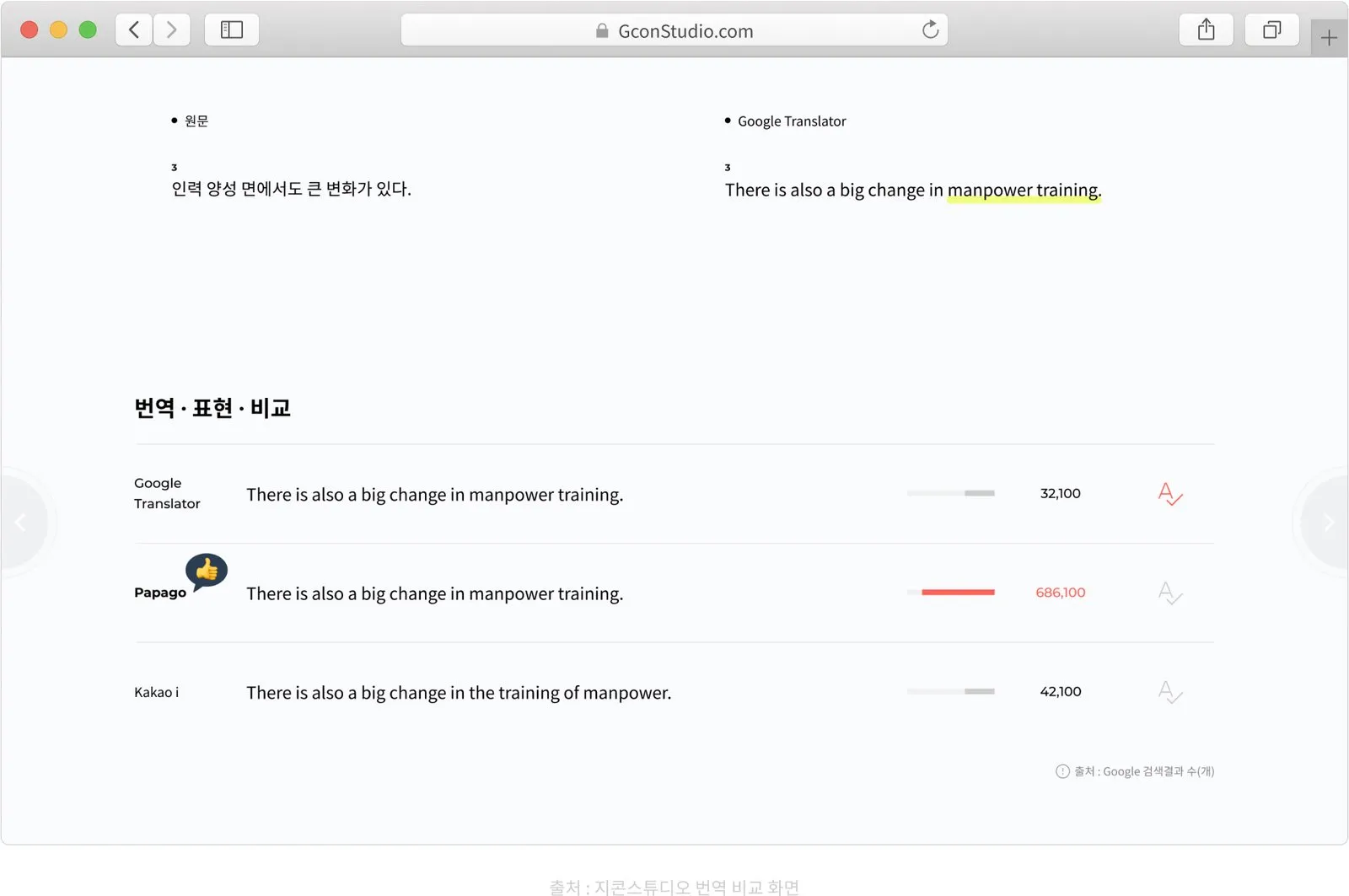
***
If you’ve ever felt uneasy about translating using awkward terms like me that you don’t actually use very often, why not try using translation recommendations from Zicon Studio from now on?
*This content has been transferred from Gicon Studio to Letterworks.
🚀데이터 인텔리전스 플랫폼 ‘레터웍스’ 지금 바로 경험해보세요.
• 노트의 내용을 실제로 이용해 보세요! (한 달 무료 이용 가능 🎉)
• AI 기술이 어떻게 적용되는지 궁금한가요? (POC 샘플 신청하기 💌)